&geometry(285x80) "Industrial and Cable Group")
Mechanical Accelerator Pedals: Choosing the Right Cable-Operated Throttle Control
 "Mechanical Accelerator Pedals: Choosing the Right Cable-Operated Throttle Control")
When reliable mechanical throttle control is essential, choosing the right mechanical accelerator pedal can make a significant difference to installation, operation and ongoing equipment performance.
For trucks, buses, agricultural machinery, construction equipment, mining applications and other industrial machinery, cable-operated accelerator pedals provide a straightforward mechanical connection between the operator's foot control and the throttle.
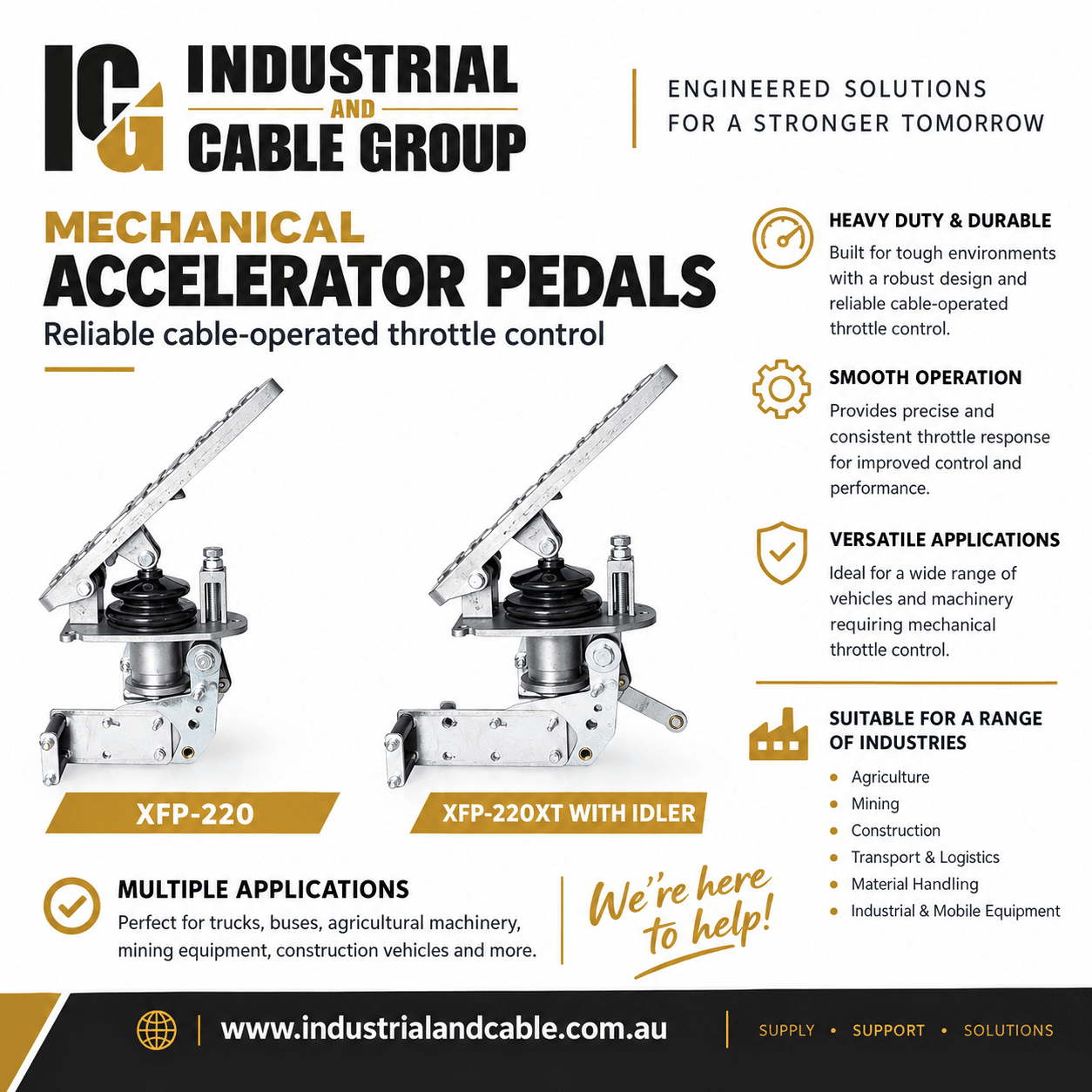
Industrial & Cable Group offers two versatile options: the XFP-220 Mechanical Accelerator Pedal and the XFP-220XT Mechanical Accelerator Pedal with Idler.
Both are designed as practical replacements for Morse / Teleflex mechanical foot pedals, while the XFP-220XT provides an additional control option for applications requiring a second throttle cable.
What is a mechanical accelerator pedal?
A mechanical accelerator pedal, sometimes called a mechanical throttle pedal, mechanical foot pedal or cable-operated accelerator pedal, uses a physical cable to transmit movement from the accelerator pedal to the engine or throttle mechanism.
Unlike electronic accelerator systems, a mechanical accelerator pedal provides a direct mechanical method of controlling throttle movement.
This makes mechanical pedals particularly useful for a wide range of commercial vehicles, agricultural machinery, construction equipment and industrial applications where robust, serviceable and adaptable mechanical controls are required.
The pedal and accelerator cable work together as a complete control system, so selecting a compatible pedal and cable configuration is important when replacing an existing installation or developing new equipment.
XFP-220 Mechanical Accelerator Pedal
The XFP-220 Mechanical Accelerator Pedal is the standard option for applications requiring a robust cable-operated accelerator pedal.
It is constructed from cast aluminium and is designed for fast installation, simple adjustment and flexible cable positioning. The pedal incorporates multiple cable entry points, allowing it to accommodate different installation configurations.
View the XFP-220 Mechanical Accelerator Pedal
A practical Morse / Teleflex replacement
One of the key advantages of the XFP-220 is that it is designed as a direct replacement for Morse / Teleflex mechanical foot pedals.
It uses the same mounting footprint, meaning that in suitable replacement applications there is no need to re-drill the mounting holes. The existing mounting position can be retained while the appropriate accelerator cable is connected.
This can be particularly valuable when machinery or vehicles need to be returned to service quickly.
Cable compatibility
The XFP-220 is designed to accept Multiflex accelerator cables including:
- Multiflex P/N 457050 clamp hub cable
- Multiflex P/N 459050 bulkhead / clamp hub cable
- Morse / Teleflex P/N 205657
- Morse / Teleflex P/N 205659
- Other compatible competitor cables
This range of compatibility makes the XFP-220 a versatile option for replacement and repair applications.
XFP-220XT Mechanical Accelerator Pedal with Idler
For applications requiring something more than a standard mechanical accelerator pedal, the XFP-220XT adds an additional lever and cable-control capability.
The XFP-220XT is constructed from aluminium with steel plate components and incorporates several features designed to provide flexibility and durability in demanding applications.
View the XFP-220XT Mechanical Accelerator Pedal with Idler
What makes the XFP-220XT different?
The most significant difference is the additional lever, which allows an extra cable to operate the throttle from outside the cabin.
This makes the XFP-220XT particularly useful for equipment where a second throttle control point is required.
The pedal also allows cable entry from any direction through 360° in the vertical plane, providing greater flexibility when routing cables around existing equipment, chassis components and other obstructions.
XFP-220 vs XFP-220XT: Which mechanical accelerator pedal do you need?
Choosing between the two pedals largely depends on the application.
| Feature | XFP-220 | XFP-220XT |
|---|---|---|
| Mechanical accelerator pedal | ? | ? |
| Cable-operated throttle control | ? | ? |
| Morse / Teleflex replacement | ? | ? |
| Multiple cable entry points | ? | ? |
| Cast aluminium construction | ? | Aluminium + steel plate components |
| Simple adjustment | ? | — |
| Built-in throttle return spring | — | ? |
| Built-in pedal stops | — | ? |
| Additional throttle lever | — | ? |
| Second cable operation | — | ? |
| 360° cable-entry flexibility | — | ? |
The XFP-220 is a strong choice when you need a standard mechanical accelerator pedal and direct replacement for an existing Morse / Teleflex pedal.
The XFP-220XT is the better option when the application requires an additional cable and secondary throttle operation, particularly where throttle control is also required outside the cabin.
Built for demanding applications
Mechanical accelerator pedals need to operate reliably in environments where equipment is regularly exposed to vibration, heavy use and challenging working conditions.
The XFP-220 and XFP-220XT are designed for applications including:
Trucks and buses
Mechanical accelerator pedals can provide a practical replacement solution for commercial vehicle applications using cable-operated throttle systems.
Agriculture
Agricultural machinery often requires robust mechanical controls that can be serviced or replaced without unnecessarily complicated systems.
Mining
The XFP-220XT is listed as suitable for mining applications, providing a flexible option where robust mechanical throttle control and additional cable operation are required.
Construction
Both pedals are suited to construction equipment requiring mechanical accelerator control.
Industrial and mobile equipment
Mechanical throttle pedals can also be used across a range of industrial and mobile machinery where a cable-operated control system is preferred.
Why cable routing matters
One of the often-overlooked considerations when replacing an accelerator pedal is cable routing.
The available space around a pedal, engine compartment, chassis or control mechanism can vary considerably between machines.
The XFP-220 provides multiple cable entry points, while the XFP-220XT takes flexibility further by allowing cable entry from any direction through 360° in the vertical plane.
This flexibility can make installation considerably easier where the cable needs to navigate around existing components.
Preventing cable over-travel
The XFP-220XT incorporates built-in pedal stops designed to prevent cable over-travel.
This is an important consideration because excessive cable travel can place unnecessary stress on the cable and associated components.
The XFP-220XT also incorporates a built-in throttle return spring, providing an additional feature within the mechanical pedal assembly.
Replacing an existing Morse or Teleflex accelerator pedal
If you're replacing an existing mechanical foot pedal, identifying the existing pedal and cable before ordering can save time and avoid compatibility issues.
Consider:
- What pedal is currently installed?
- What is the existing mounting footprint?
- What type of accelerator cable is being used?
- Where does the cable enter the pedal?
- Is a second throttle control required?
- Does the application require additional cable-routing flexibility?
For suitable Morse / Teleflex replacement applications, the XFP-220 and XFP-220XT provide straightforward replacement options.
Need help choosing the right mechanical accelerator pedal?
Selecting the correct pedal isn't always as simple as matching a product photograph.
The pedal, cable, mounting arrangement and throttle mechanism all need to work together.
If you're replacing an existing pedal, upgrading a vehicle or machinery control system, or developing a new application, Industrial & Cable Group can help you identify the most appropriate solution.
You can start by comparing the two products:
XFP-220 Mechanical Accelerator Pedal
XFP-220XT Mechanical Accelerator Pedal with Idler
Not sure which one you need? Contact Industrial & Cable Group with details or photographs of your existing pedal and cable, and the team can help you work through the options.
Mechanical accelerator pedals from Industrial & Cable Group
From Morse / Teleflex replacement pedals through to mechanical accelerator cables, controls and associated components, Industrial & Cable Group provides solutions for industrial, mobile, agricultural, transport, mining and construction applications.
Need a mechanical accelerator pedal?
XFP-220 — standard mechanical accelerator pedal for straightforward cable-operated throttle applications.
XFP-220XT — mechanical accelerator pedal with idler and additional lever for applications requiring secondary throttle cable operation.
Explore Mechanical Foot Pedals at Industrial & Cable Group
We're here to help you find the right solution for your application.
 "Industrial and Cable Group") Author:Industrial and Cable Group
Author:Industrial and Cable Group