&geometry(285x80) "Industrial and Cable Group")
Ball Joints
FREE Shipping on orders over $150
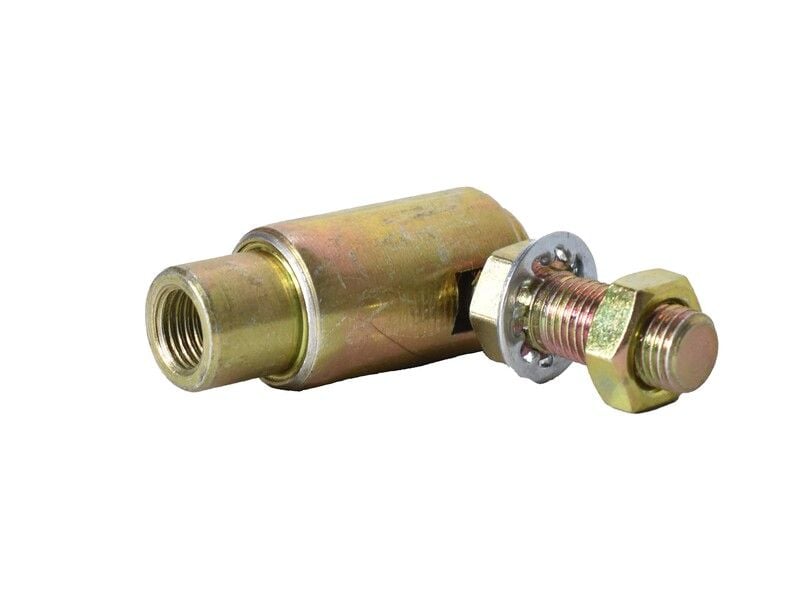
Industrial and Cable Group Ball Joints are designed for reliable motion control and linkage applications across industrial, agricultural, transport and mobile equipment industries. Commonly used with push-pull cables, throttle controls, shifter cables and mechanical linkage systems, ball joints provide smooth articulation and dependable connection points where movement and alignment flexibility are required.
Available in a range of fixed and quick release styles, Ball Joints are suitable for light to medium-duty control applications and are commonly used in machinery, engine controls, cable assemblies and equipment requiring efficient linkage movement. Industrial and Cable Group offers a variety of thread sizes and configurations to suit replacement and custom applications.
For assistance selecting the correct Ball Joint for your application, contact Industrial and Cable Group Contact Us.
What is a cable ball joint?
A cable ball joint is a mechanical linkage component used to connect a control cable to a lever, actuator or other mechanism. Its articulated design allows movement between the cable and the mechanism while maintaining controlled movement.
What are cable ball joints used for?
Cable ball joints are commonly used with push-pull control cables, throttle cables, shifter cables and other mechanical control cable systems. They can be used in industrial machinery, transport equipment, agricultural machinery, marine applications and other mechanical linkage systems.
What is a quick disconnect ball joint?
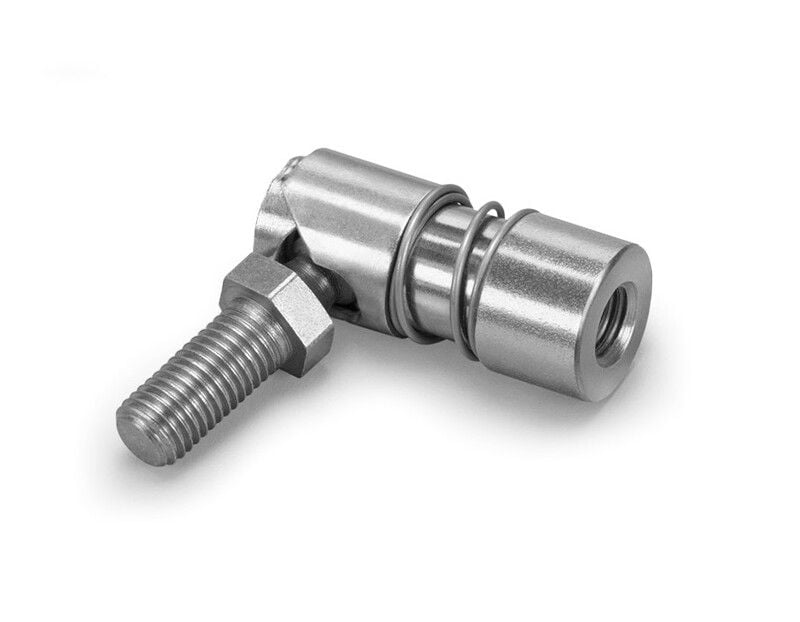
A quick disconnect ball joint uses a spring-loaded mechanism that allows the ball joint to be disconnected from its stud without completely removing the component from the assembly.
What is the difference between a quick release and quick disconnect ball joint?
In this product range, the terms describe the same general style of ball joint. Both refer to a spring-loaded housing that can be moved to release the stud.
What thread sizes are available?
The range includes metric sizes such as M6 x 1.00, M8 x 1.25 and M10 x 1.50, as well as UNF sizes including 3/16", 1/4", 5/16" and 3/8".
Are these ball joints suitable for suspension applications?
The plated steel metric ball joints in this range are intended for light-duty mechanical control cable applications and should not be used for suspension components or sway bar end links.
How do I choose the correct ball joint?
Check the required thread size, stud size, available space, connection type and application load. For quick disconnect models, also confirm that the quick-release function suits the installation.
Can ball joints be used with push-pull cables?
Yes. These ball joints are commonly used with push-pull control cables and are also suitable for many shifter and throttle cable applications.
Can I use a ball joint with a throttle cable?
Yes. Ball joints in this range are commonly used in throttle cable and mechanical throttle linkage applications.
What is the difference between a ball joint and a clevis?
A ball joint provides an articulated connection that allows angular movement, while a clevis provides a more fixed pin-and-fork style mechanical connection. The correct choice depends on the cable and linkage design.
)
)