&geometry(285x80) "Industrial and Cable Group")
The Complete Guide to Ball Joints, Rod Ends and Clevises
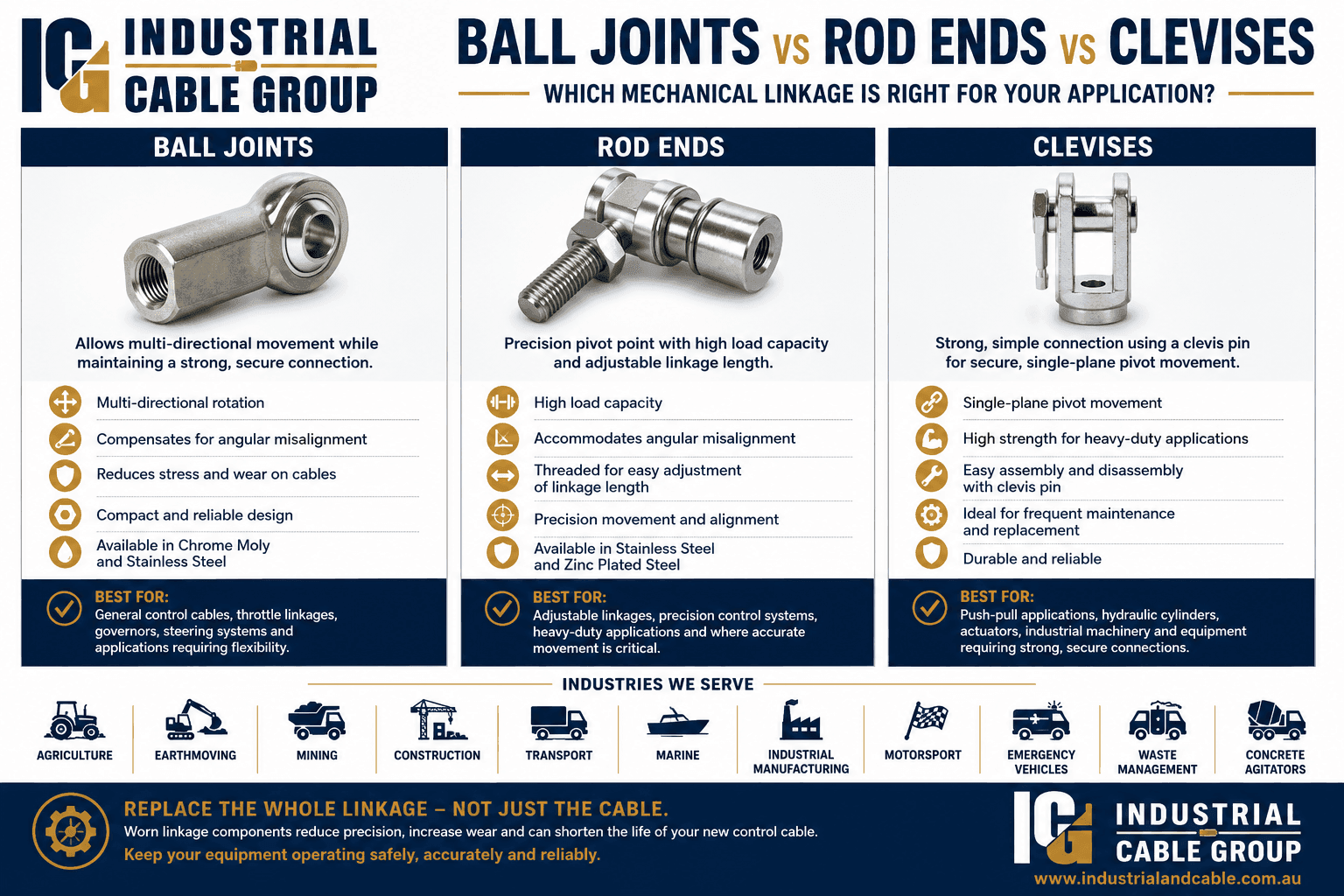 "The Complete Guide to Ball Joints, Rod Ends and Clevises")
When people think about mechanical control systems, they often focus on the control cable itself. But every reliable control system is only as strong as the components that connect it.
Ball joints, spherical rod ends and clevises are essential mechanical linkage components that transfer movement from the cable to the equipment being controlled. Whether you're operating heavy machinery, marine controls, agricultural equipment or industrial automation, these accessories play a critical role in ensuring smooth, accurate and reliable operation.
At Industrial & Cable Group, we stock a comprehensive range of high-quality ball joints, rod ends and clevises designed to work seamlessly with our motion control cables across countless industrial applications.
In this guide, we'll explain what each component does, where they're used, how to choose the correct option, and why replacing worn linkage hardware is just as important as replacing the control cable itself.
Why Linkage Components Matter
A mechanical control cable transmits movement from an operator to a machine.
However, the cable itself cannot perform this task alone.
The connection between the cable and the moving component must allow for movement, vibration, alignment changes and varying loads while remaining secure and accurate.
This is where linkage components become essential.
These components:
- Transfer motion efficiently
- Allow controlled angular movement
- Reduce stress on cables
- Minimise wear
- Improve operating accuracy
- Extend the service life of the complete control system
Without quality linkage hardware, even the best control cable will eventually suffer premature wear or failure.
What is a Ball Joint?
A ball joint is a mechanical connector that allows movement in multiple directions while maintaining a secure connection between two components.
It consists of:
- A spherical ball stud
- A housing
- A threaded connection
- A retaining mechanism
Because the ball can rotate within its housing, ball joints compensate for angular misalignment while still transmitting push and pull forces efficiently.
Ball joints are commonly used on:
- Mechanical control cables
- Engine throttle linkages
- Governor controls
- Gear selectors
- Agricultural equipment
- Marine steering systems
- Industrial machinery
- Construction equipment
- Mining machinery
Industrial & Cable Group supplies both Chrome Moly and Stainless Steel Ball Joints to suit demanding operating environments, offering excellent corrosion resistance and long service life.
What is a Spherical Rod End?
A spherical rod end (sometimes called a Rose Joint or Heim Joint) is a threaded mechanical joint that incorporates a spherical bearing within a housing.
Unlike a standard ball joint, rod ends are designed to:
- Carry higher loads
- Accommodate angular misalignment
- Provide precise movement
- Allow threaded adjustment of linkage length
This makes them ideal wherever accurate motion transfer is critical.
Rod ends are available with:
- Male threads
- Female threads
- Left-hand threads
- Right-hand threads
- Stainless steel construction
- Zinc-plated steel construction
The spherical bearing allows movement through a wide range of operating angles while reducing binding and excessive stress on connected components.
Common Applications for Rod Ends
Rod ends are found throughout industry, including:
- Heavy vehicles
- Mining equipment
- Earthmoving machinery
- Agricultural machinery
- Marine controls
- Motorsport
- Industrial automation
- Manufacturing equipment
- Hydraulic systems
- Packaging machinery
Their ability to accommodate slight misalignment while maintaining strength makes them one of the most versatile mechanical linkage components available.
What is a Clevis?
A clevis is a U-shaped mechanical connector that joins two components using a removable clevis pin.
Unlike ball joints or rod ends, a clevis primarily allows movement in a single plane while providing an exceptionally strong connection for push-pull applications.
Clevises are widely used where:
- High strength is required
- Easy assembly is important
- Regular maintenance is expected
- Components require quick replacement
Most clevis assemblies consist of:
- Threaded clevis body
- Clevis pin
- Retaining clip or split pin
This simple yet highly effective design has been trusted across industry for decades.
Typical Clevis Applications
Clevises are commonly used on:
- Mechanical control cables
- Hydraulic cylinders
- Industrial actuators
- Agricultural machinery
- Marine controls
- Construction equipment
- Earthmoving machinery
- Heavy transport
- Mining equipment
Their robust design makes them particularly suitable for heavy-duty industrial environments.
Ball Joint vs Rod End vs Clevis
Although these components often perform similar roles, each is designed for different operating conditions.
| Component | Primary Movement | Best Used For |
|---|---|---|
| Ball Joint | Multi-directional movement | General mechanical linkages requiring flexibility |
| Spherical Rod End | High-load angular movement with adjustment | Precision control systems and adjustable linkages |
| Clevis | Single-plane pivot | Heavy-duty push-pull applications requiring strength and simplicity |
Selecting the correct component depends on:
- Operating load
- Required movement
- Installation space
- Environmental conditions
- Adjustment requirements
- Maintenance frequency
Industries That Depend on These Components
Industrial & Cable Group supplies motion control cables and linkage accessories to customers across Australia and New Zealand working in a diverse range of industries, including:
- Agriculture
- Earthmoving
- Construction
- Mining
- Transport
- Heavy vehicles
- Marine
- Industrial manufacturing
- Motor racing
- Emergency vehicles
- Waste management
- Concrete agitators
- Utilities
- Industrial automation
Wherever equipment relies on mechanical motion control, reliable linkage components are essential to maintaining safe and efficient operation.
Why These Components Should Be Replaced During Maintenance
One of the most common maintenance mistakes is replacing only the control cable while reusing worn linkage hardware.
Even if a cable is brand new, excessive wear in the connecting components can result in:
- Lost motion
- Poor throttle response
- Gear selection issues
- Increased vibration
- Premature cable wear
- Reduced operating accuracy
- Unexpected downtime
Replacing worn ball joints, rod ends and clevises at the same time as the cable helps restore the entire control system to optimal performance.
This approach also reduces future maintenance costs by preventing uneven loading and accelerated wear on new components.
Signs Your Linkage Components Need Replacing
Inspect linkage components regularly for:
- Excessive movement or play
- Corrosion
- Cracked housings
- Bent pins
- Worn threads
- Stiff movement
- Seized bearings
- Damaged retaining clips
- Visible wear on spherical bearings
If any of these issues are present, replacement is usually the safest and most cost-effective solution.
Why Choose Industrial & Cable Group?
Industrial & Cable Group specialises in complete motion control systems—not just cables.
Our extensive range includes:
- Ball Joints
- Spherical Rod Ends
- Clevises
- Cable Clamps
- Wire Stops
- Pivots
- Fasteners
- Hand Controls
- Foot Controls
- Mechanical Control Cables
Backed by the manufacturing expertise of Multiflex Australia, our products are designed for demanding Australian conditions and supported by genuine technical knowledge.
Whether you're repairing a single machine or maintaining an entire fleet, our experienced team can help you select the right linkage components to ensure reliable, long-lasting performance.
Keep Your Motion Control System Performing at Its Best
Every movement in a mechanical control system relies on quality connections.
Ball joints, spherical rod ends and clevises may be small components, but they have a major impact on the safety, precision and longevity of your equipment.
When maintaining or upgrading your machinery, don't overlook the components that connect everything together. Replacing worn linkage hardware alongside your control cables is one of the simplest ways to improve reliability, reduce downtime and extend the life of your entire motion control system.
Explore the complete range of Ball Joints, Spherical Rod Ends and Clevises available from Industrial & Cable Group and keep your equipment operating at its best.
Need help choosing the right linkage components?
Whether you're replacing a worn ball joint, selecting the correct rod end or matching a clevis to a new control cable, the team at Industrial & Cable Group can help. Browse our extensive range online or contact our technical team for expert advice on finding the right solution for your application.
What is the difference between a ball joint and a rod end?
A ball joint allows multi-directional movement while maintaining a secure connection, making it ideal for general motion control applications. A rod end incorporates a spherical bearing and threaded body, allowing precise adjustment and handling higher loads.
What is a clevis used for?
A clevis creates a strong pivot connection using a clevis pin. It is commonly used on push-pull control cables, hydraulic cylinders and industrial machinery where movement is required in a single plane.
When should linkage components be replaced?
Linkage components should be replaced if they show excessive play, corrosion, damaged threads, worn bearings or stiffness. Replacing them alongside a new control cable helps maintain accurate operation and extends the life of the entire system.
Which industries use ball joints, rod ends and clevises?
These components are widely used in agriculture, mining, construction, marine, transport, earthmoving, emergency vehicles, waste management, industrial manufacturing, motorsport and many other industries that rely on mechanical motion control systems.
Can I replace only the control cable?
While you can replace only the cable, it is generally recommended to inspect and replace worn linkage components at the same time. This restores the entire motion control system, improves reliability and helps prevent premature wear of the new cable.
 "Industrial and Cable Group") Author:Industrial and Cable Group
Author:Industrial and Cable Group