&geometry(285x80) "Industrial and Cable Group")
Don't Just Replace The Cable — Replace The Fittings Too
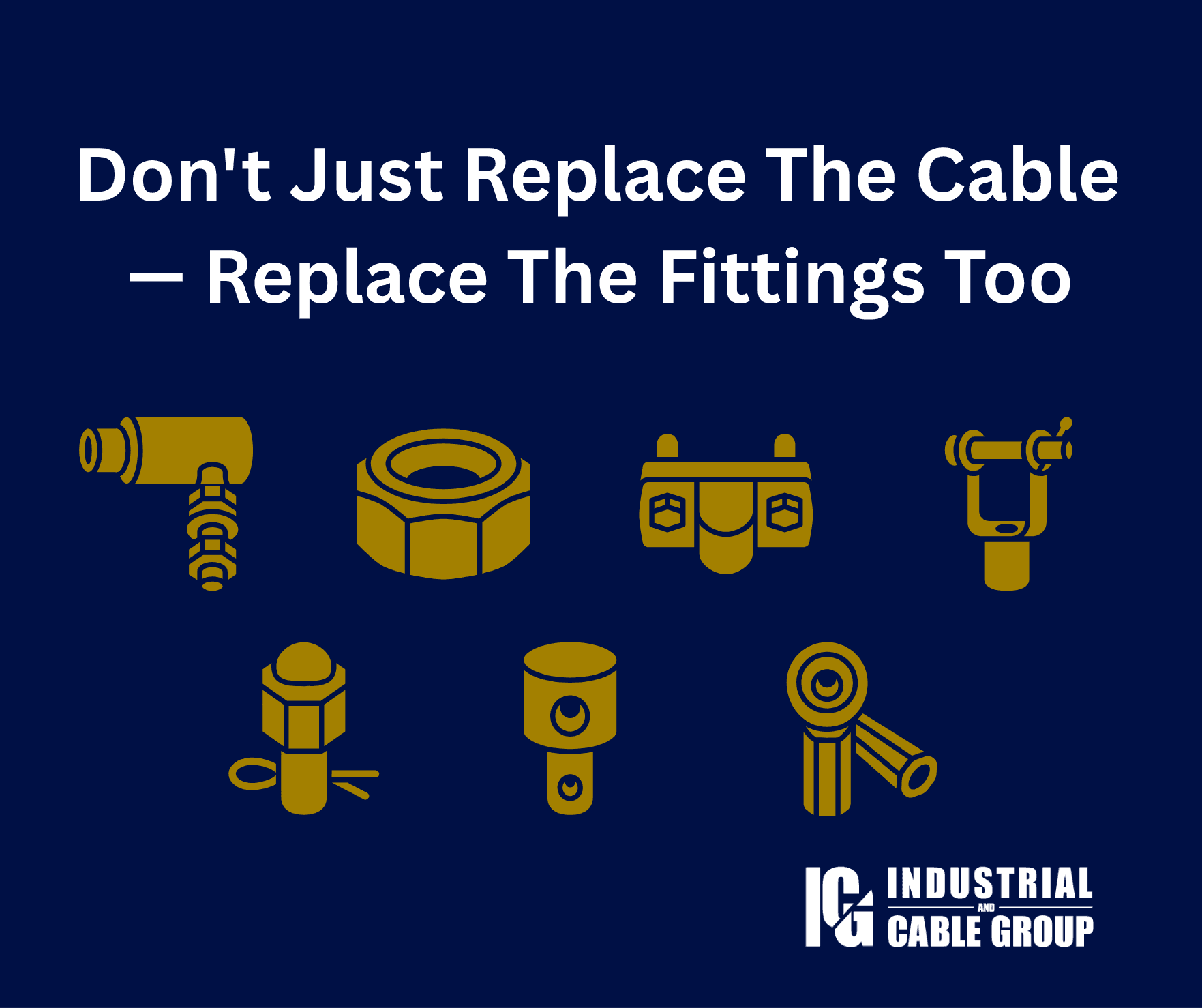 "Don't Just Replace The Cable — Replace The Fittings Too")
Industrial & Cable Group | Technical Guide | Mechanical Control Systems
A new control cable is only as good as the hardware it connects to. Every fitting, clamp, and fastener in the system matters — and worn accessories undo the benefits of a fresh cable before you've even finished the job.
INTRODUCTION
When a mechanical control cable fails — whether it's a throttle cable on a piece of agricultural machinery, a shift cable on a marine vessel, or a push-pull cable on industrial equipment — the instinct is simply to source a replacement cable and get back up and running. That makes sense. But there's a step that's easy to skip and expensive to regret: refreshing all the hardware accessories that connect, route, and anchor that cable throughout the system.
Control cables don't operate in isolation. Every cable runs through a system of ball joints, clevises, clamps, rod ends, pivots, wire stops, and fasteners that collectively determine how well the cable performs, how precisely it transmits force, and how long it lasts. If those components are corroded, worn, or play-affected, a new cable will feel and behave almost identically to the old one — and may wear out faster.
THE RULE OF THUMB
If a cable has worn out from age, vibration, or environmental exposure, it's virtually certain the hardware around it has too. Replacing fittings at the same time is not extra spend — it's protecting the investment in the new cable.
Below is a rundown of every hardware category required when fitting or replacing mechanical control cables, with a clear explanation of what each component does and why it belongs in your replacement kit.
THE ESSENTIAL HARDWARE ACCESSORIES
Ball joints provide the articulation point where the cable end connects to a lever, bracket, or linkage arm. They allow smooth angular movement in multiple planes while transmitting push-pull force reliably. Available in fixed and quick-release styles, in plated steel for general use and stainless steel for corrosive or marine environments.
Common in: Throttle controls | Shifter cables | Engine linkages | Industrial machinery
Cable clamps anchor the outer sheath of a control cable to chassis, frames, or brackets at key points along the cable run. Proper clamping prevents cable flex beyond the designed radius, reduces vibration-induced wear, and keeps the cable away from heat sources and moving parts. ICG stocks clamps for heavy-duty and universal control cables, plus stainless steel quick-release options.
Common in: Cable routing | Chassis mounting | Marine installations
A clevis is the U-shaped fork fitting that allows a cable end or rod end to connect to a pin on a lever or actuator. They transfer linear cable force into rotational movement at the attachment point, while allowing slight angular misalignment. ICG offers clevises in both imperial and metric thread sizes, in plated steel, to suit replacement and custom fabrication jobs.
Common in: Lever connections | Actuator linkages | Agricultural machinery
Rod ends incorporate a spherical bearing that allows multi-axis articulation at threaded connection points, making them ideal where precise angular alignment is critical or unavoidable. Available in chrome moly, stainless steel, and steel housing with nylon race options, with male and female thread configurations in both metric and imperial sizes.
Common in: Steering systems | Control linkages | Throttle assemblies | Transport equipment
Jam nuts lock threaded cable end fittings — ball joints, rod ends, and clevises — securely in position once the correct adjustment has been set. Without them, vibration will gradually walk the fitting out of adjustment, introducing unwanted free play. ICG carries jam nuts in stainless steel, metric, and imperial thread sizes to match any fitting in your system.
Common in: Locking ball joints | Securing rod ends | All cable end fittings
Pivot fittings serve as the fixed anchor point at the cable's outer sheath termination — the location where the cable transitions from free run into its connection with the controlled component. Cable end pivots and pivot foot pedal assemblies allow the inner wire to travel freely while keeping the outer sheath firmly located, which is fundamental to how push-pull cables transmit force.
Common in: Sheath termination | Foot pedal controls | Cable anchor points
Wire stops are small but critical components that fix onto the inner wire to create a positive stop — limiting cable travel and preventing the wire from pulling through fittings under load. Available in barrel style for in-line applications and pivot style for angled or offset connections. A worn or missing wire stop is one of the most common causes of sudden, total loss of control function.
Common in: Travel limiting | Wire retention | Control cable assemblies
WHY YOU SHOULD ALWAYS REFRESH FITTINGS ON CABLE REPLACEMENT
It's a straightforward principle: cables and their fittings age together. By the time a cable needs replacing, the ball joints, clevises, and rod ends at each end have endured the same vibration cycles, temperature swings, and corrosive exposure. The threads are likely fatigued, the bearing surfaces worn, and the jam nuts may no longer hold adjustment reliably.
Installing a precision new cable onto degraded fittings means the system will feel and respond poorly from day one. Free play in a worn ball joint or rod end is indistinguishable from cable stretch — you'll be chasing an adjustment problem that isn't actually in the cable. Worse, a corroded clamp that was barely holding position may fail entirely once the new cable is under load.
Refreshing fittings at replacement time also pays forward. Cable life is heavily influenced by correct clamping, correct alignment at end fittings, and proper sheath termination. Fresh, correctly rated hardware gives the new cable the best possible working conditions from the start.
THE REPLACEMENT CHECKLIST
Before closing out any mechanical control cable replacement, work through the following:
[ ] Inspect both ball joints for looseness, corrosion, or cracked housings — replace both ends, not just the visible bad one.
[ ] Check clevises for pin wear and thread condition. A clevis with sloppy pin clearance introduces free play the cable cannot compensate for.
[ ] Replace jam nuts as a matter of course — they are inexpensive and a loose jam nut is the leading cause of unexpected adjustment loss.
[ ] Inspect every cable clamp along the run. Look for rust, cracked nylon inserts, and distorted brackets. Replace any that don't hold the cable firmly in position.
[ ] Check pivots at each sheath end. A damaged pivot seat allows the outer sheath to move when it should be fixed, robbing the system of cable travel.
[ ] Verify wire stops are secure and undamaged. Replace if there is any sign of slippage, corrosion, or deformation.
[ ] If rod ends are part of the system, check spherical bearing play. Any roughness or binding means replacement — a seized rod end puts the cable under off-axis stress immediately.
Industrial and Cable Group stocks all of these components and can assist with selecting the correct specifications for your application. Metric and imperial threads, plated and stainless steel options, and a range of sizes are available to suit both original equipment replacement and custom builds across agricultural, industrial, transport, and marine applications.
Free shipping applies on orders over $150 — making it straightforward to order a complete hardware kit alongside your replacement cable.
NEED HELP SELECTING THE RIGHT HARDWARE?
Contact the Industrial & Cable Group team — we'll help match the correct fittings to your cable and application.
Phone: +61 2 8911 1533
Website: https://www.industrialandcable.com.au
Contact: https://www.industrialandcable.com.au/contact-us.html
Address: Unit 3, 4 Beaumont Road, Mt Kuring-gai NSW 2080
 "Industrial and Cable Group") Author:Industrial and Cable Group
Author:Industrial and Cable Group