&geometry(285x80) "Industrial and Cable Group")
Which Rod End Do I Need? A Guide to Chrome Moly, Stainless Steel and Nylon Race Rod Ends
 "Which Rod End Do I Need? A Guide to Chrome Moly, Stainless Steel and Nylon Race Rod Ends")
Rod ends are used in a wide variety of industrial, mechanical and control applications, but choosing the right one can sometimes be confusing.
Should you choose chrome moly or stainless steel? Do you need a steel housing nylon race? Does the application use metric or imperial threads? And if you are replacing a control cable, should you replace the rod ends and connecting hardware at the same time?
The answer depends on the application, operating environment and the type of movement and load the component needs to handle.
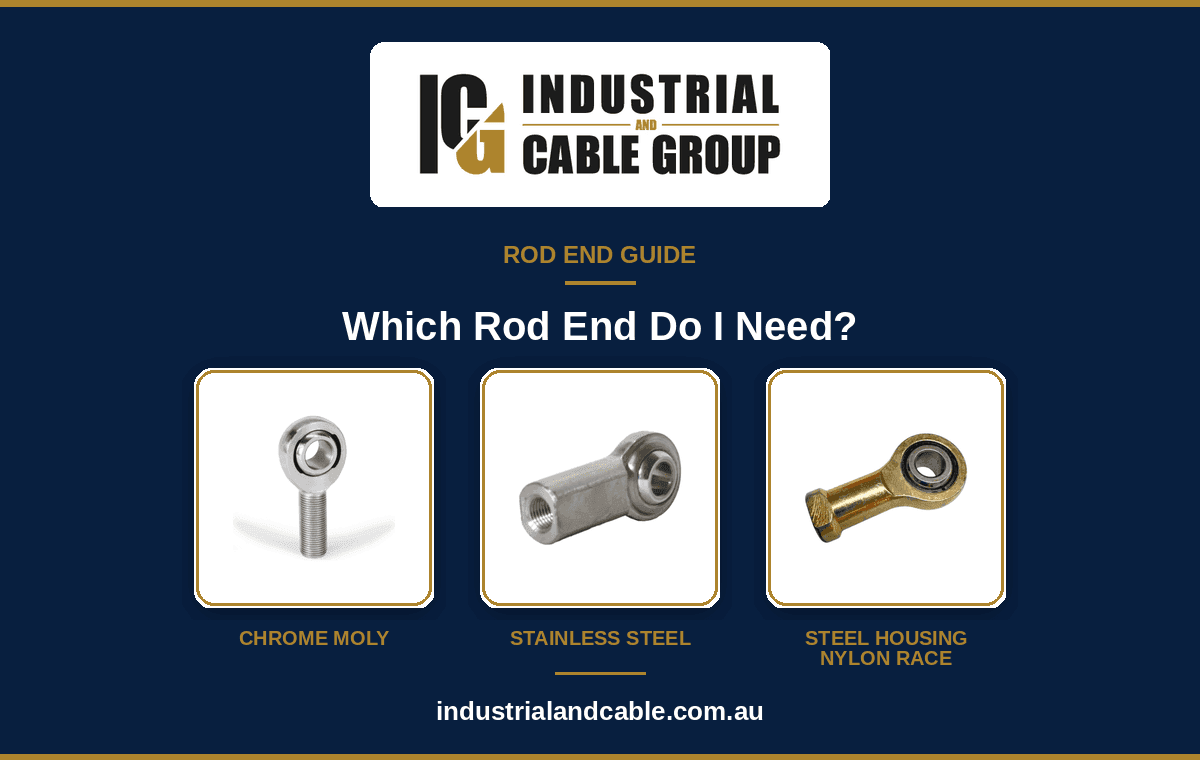
At Industrial & Cable Group, we stock three main categories of rod ends:
Each range is designed to suit different applications and environments, with options available in metric and imperial sizes across the range.
This guide will help you understand the differences and identify which type of rod end may be suitable for your application.
What Is a Rod End?
A rod end, sometimes called a spherical rod end or heim joint, is a mechanical component designed to create a secure connection while allowing movement and angular misalignment.
Typically consisting of a threaded housing with a spherical ball or bearing, a rod end allows connected components to pivot as machinery, linkages or control systems move.
Rod ends are commonly used in:
Industrial machinery
Mechanical linkages
Agricultural equipment
Manufacturing equipment
Automotive and motorsport applications
Marine equipment
Actuator and cylinder linkages
Throttle, clutch and gear controls
Custom mechanical assemblies
Because they are often located at the connection point between moving components, rod ends can experience repeated movement, vibration and load. Choosing the right material and design for the application is therefore important.
The Three Types of Rod Ends We Stock
1. Chrome Moly Rod Ends – For High-Strength Applications
Chrome moly rod ends are designed for applications where strength and durability are important.
Chrome moly, or chromium-molybdenum steel, is commonly used in demanding mechanical applications due to its strength characteristics.
Industrial & Cable Group's Chrome Moly Rod Ends feature a steel housing manufactured from 4130 heat-treated chrome moly steel, with a bright chrome-plated finish and hard chrome-plated ball. They also feature a slotted nylon bearing race.
This combination makes them well suited to applications where a strong, durable rod end is required.
Typical applications may include:
High-load mechanical linkages
Industrial machinery
Heavy-duty equipment
Automotive applications
Motorsport and performance equipment
Custom mechanical assemblies
Chrome moly rod ends can be an excellent choice where the application places greater emphasis on mechanical strength and durability.
However, as with any rod end, the correct size, thread, bore and movement requirements should always be checked before selecting a replacement.
2. Stainless Steel Rod Ends – For Corrosion Resistance
Stainless steel rod ends are particularly useful where corrosion resistance is an important consideration.
Equipment operating outdoors, around water or in environments where moisture is regularly present can place greater demands on connecting hardware.
Stainless steel rod ends may be suitable for applications including:
Marine equipment
Outdoor machinery
Agricultural equipment
Wash-down environments
Food and processing equipment
Equipment exposed to moisture
Corrosive environments
When selecting a stainless steel rod end, it is still important to ensure that the thread size, ball bore, dimensions and mechanical requirements are correct for the application.
Stainless steel is not simply an upgrade for every application. The best choice depends on the environment and the specific mechanical requirements of the system.
Where corrosion and environmental exposure are major considerations, a stainless steel rod end may provide the most suitable solution.
3. Steel Housing / Nylon Race Rod Ends – For General Industrial Applications
Steel Housing / Nylon Race Rod Ends provide a practical option for a wide range of industrial and mechanical applications.
These rod ends feature a steel housing and a nylon bearing race designed to support smooth movement between connected components.
They are commonly suited to applications such as:
Industrial control systems
Push-pull cable connections
Machinery linkages
Agricultural equipment
Manufacturing machinery
General mechanical applications
Vehicle controls
Custom-built equipment
For many customers, this category will be the starting point when replacing a worn rod end in a general industrial application.
The combination of a steel housing and nylon race provides a practical solution for applications where the operating environment does not require the additional corrosion resistance of stainless steel or the specific strength characteristics of chrome moly.
Chrome Moly, Stainless Steel or Steel Housing / Nylon Race?
The easiest way to choose between the three categories is to first consider what the rod end will be exposed to and what it needs to do.
| Rod End Type | Primary Consideration | Best Suited To |
|---|---|---|
| Chrome Moly | Strength and durability | Demanding mechanical, high-strength and heavy-duty applications |
| Stainless Steel | Corrosion resistance | Marine, outdoor, wet and corrosive environments |
| Steel Housing / Nylon Race | Practical general-purpose performance | Industrial machinery, control systems and general mechanical applications |
The material is only one part of the selection process.
You also need to make sure the rod end physically fits the application.
Metric or Imperial – How Do I Know Which Thread I Need?
One of the most important steps when replacing a rod end is identifying the existing thread.
Industrial equipment may use either metric or imperial threads, and components that appear to be similar in size may not be interchangeable.
Metric threads are identified using sizes such as:
M6
M8
M10
M12
Imperial threads may use sizes such as:
1/4"
5/16"
3/8"
1/2"
The thread pitch is equally important.
A rod end with a similar diameter but an incorrect thread pitch can damage the mating component if forced into place.
Before ordering a replacement, check:
Thread diameter
Thread pitch
Metric or imperial sizing
Male or female thread
Right-hand or left-hand thread
Thread engagement or length
If you are replacing a rod end connected to a control cable, measure the thread on the cable itself rather than assuming the replacement will use the same dimensions.
Replacing a Control Cable? Check the Rod Ends Too
When a control cable is worn or damaged, replacing the cable is an obvious priority.
However, the cable is only one part of the complete control system.
At either end of the cable, there may be rod ends, ball joints, clevises, cable pivots, pins, clips or jam nuts connecting the cable to the equipment it controls.
These components are subject to repeated movement and can gradually wear, loosen or corrode.
Installing a new control cable while leaving a worn rod end in place can result in continued problems such as:
Excessive play or lost motion
Reduced control accuracy
Poor alignment
Noise or vibration
Additional stress on the new cable
Uneven movement
Premature wear of other components
Replacing a cable provides an excellent opportunity to inspect the complete linkage.
Check the condition of the rod ends and other connecting hardware before installing the new cable.
If a rod end is loose, worn, damaged or significantly corroded, replacing it at the same time can help restore the complete system rather than simply replacing one component.
How to Identify a Replacement Rod End
If you are replacing an existing rod end, the following measurements and details will help identify the correct replacement.
1. Thread Size and Type
Determine whether the thread is metric or imperial and measure both the diameter and thread pitch.
2. Male or Female Thread
Check whether the rod end has an externally threaded shank or an internally threaded housing.
3. Thread Direction
Most applications use right-hand threads, but some linkage systems use left-hand threads.
Always confirm before ordering.
4. Ball Bore Diameter
Measure the hole through the spherical ball to ensure it will fit the existing bolt, pin or mounting point.
5. Housing Dimensions
Check the width and overall dimensions of the existing rod end, particularly where space or clearance is limited.
6. Operating Environment
Consider whether the component is exposed to:
Moisture
Saltwater
Outdoor conditions
Dirt and contamination
Chemicals
Frequent wash-down
This will help determine whether stainless steel, chrome moly or a steel housing / nylon race rod end is the most appropriate choice.
7. Strength and Application Requirements
Consider how the component is being used.
A general industrial cable linkage may have very different requirements from a high-load mechanical assembly or equipment exposed to marine conditions.
Always select the rod end based on the requirements of the complete application, rather than simply choosing the closest physical match.
Which Rod End Should I Choose?
If you are still unsure, this simple guide can help narrow down your options.
Choose a Chrome Moly Rod End if:
Your application requires a strong and durable component for demanding mechanical or high-strength applications.
Choose a Stainless Steel Rod End if:
Corrosion resistance is a priority and the equipment is exposed to moisture, weather, marine conditions or other potentially corrosive environments.
Choose a Steel Housing / Nylon Race Rod End if:
You need a practical rod end for general industrial machinery, mechanical linkages or control cable applications.
Once you have selected the most appropriate material and style, confirm the thread, ball bore and dimensions against your existing component.
Need Help Finding the Right Rod End?
The easiest way to identify a replacement rod end is to start with the existing component.
Measure the thread, ball bore and key dimensions, and consider where and how the rod end will be used.
If you are unsure, gather as much information as possible, including:
Photos of the existing rod end
Thread diameter and pitch
Metric or imperial sizing
Male or female thread
Ball bore diameter
Overall dimensions
Details about the application
Information about the operating environment
Industrial & Cable Group stocks Chrome Moly, Stainless Steel and Steel Housing / Nylon Race Rod Ends for a range of industrial, mechanical and cable applications.
If you are replacing a control cable, remember to inspect the complete connection system at the same time.
A new cable can only perform as well as the components connecting it.
By checking rod ends, ball joints, clevises, cable pivots and other hardware when replacing a cable, you can help reduce unnecessary play, improve alignment and restore smoother, more reliable operation across the complete system.
1. Which rod end do I need?
The right rod end depends on the application, operating environment, thread type, ball bore, dimensions and strength requirements. Industrial & Cable Group stocks chrome moly, stainless steel and steel housing / nylon race rod ends for different industrial and mechanical applications.
2. What is the difference between chrome moly, stainless steel and nylon race rod ends?
Chrome moly rod ends are suited to demanding applications where strength and durability are important. Stainless steel rod ends are selected where corrosion resistance is a priority. Steel housing / nylon race rod ends provide a practical option for many general industrial, mechanical and control cable applications.
3. When should I use a chrome moly rod end?
A chrome moly rod end may be suitable where the application requires a strong and durable component for demanding mechanical, high-load or heavy-duty applications.
4. When should I use a stainless steel rod end?
Stainless steel rod ends are particularly suitable where corrosion resistance is important, including marine, outdoor, wet or moisture-exposed applications.
5. What is a steel housing nylon race rod end used for?
Steel housing / nylon race rod ends are commonly used in general industrial machinery, mechanical linkages, push-pull cable connections, vehicle controls and other applications requiring controlled movement and articulation.
6. How do I know if my rod end is metric or imperial?
Measure the thread diameter and pitch. Metric rod ends use measurements such as M6, M8, M10 and M12, while imperial rod ends may use sizes such as 1/4", 5/16", 3/8" or 1/2". Always confirm both diameter and pitch before ordering.
7. What measurements do I need to replace a rod end?
Check the thread diameter, thread pitch, thread direction, male or female thread, ball bore diameter, housing width, thread length and overall dimensions.
8. Should I replace rod ends when replacing a control cable?
Yes, replacing a control cable is a good opportunity to inspect the complete connection system. Worn or loose rod ends can cause excessive play, poor alignment and reduced control accuracy, even when a new cable has been installed.
9. What are the signs that a rod end needs replacing?
Signs may include excessive movement or play, visible wear, corrosion, damage, binding, rough movement or a loose connection. The component should be inspected to determine whether replacement is required.
10. Can rod ends be used with industrial control cables?
Yes. Rod ends are commonly used to connect industrial control cables to levers, linkages and other moving components. The correct rod end must match the thread, mounting arrangement, movement and mechanical requirements of the application.
 "Industrial and Cable Group") Author:Industrial and Cable Group
Author:Industrial and Cable Group