&geometry(285x80) "Industrial and Cable Group")
Control Cables Australia: The Complete Guide to Mechanical Control Cables
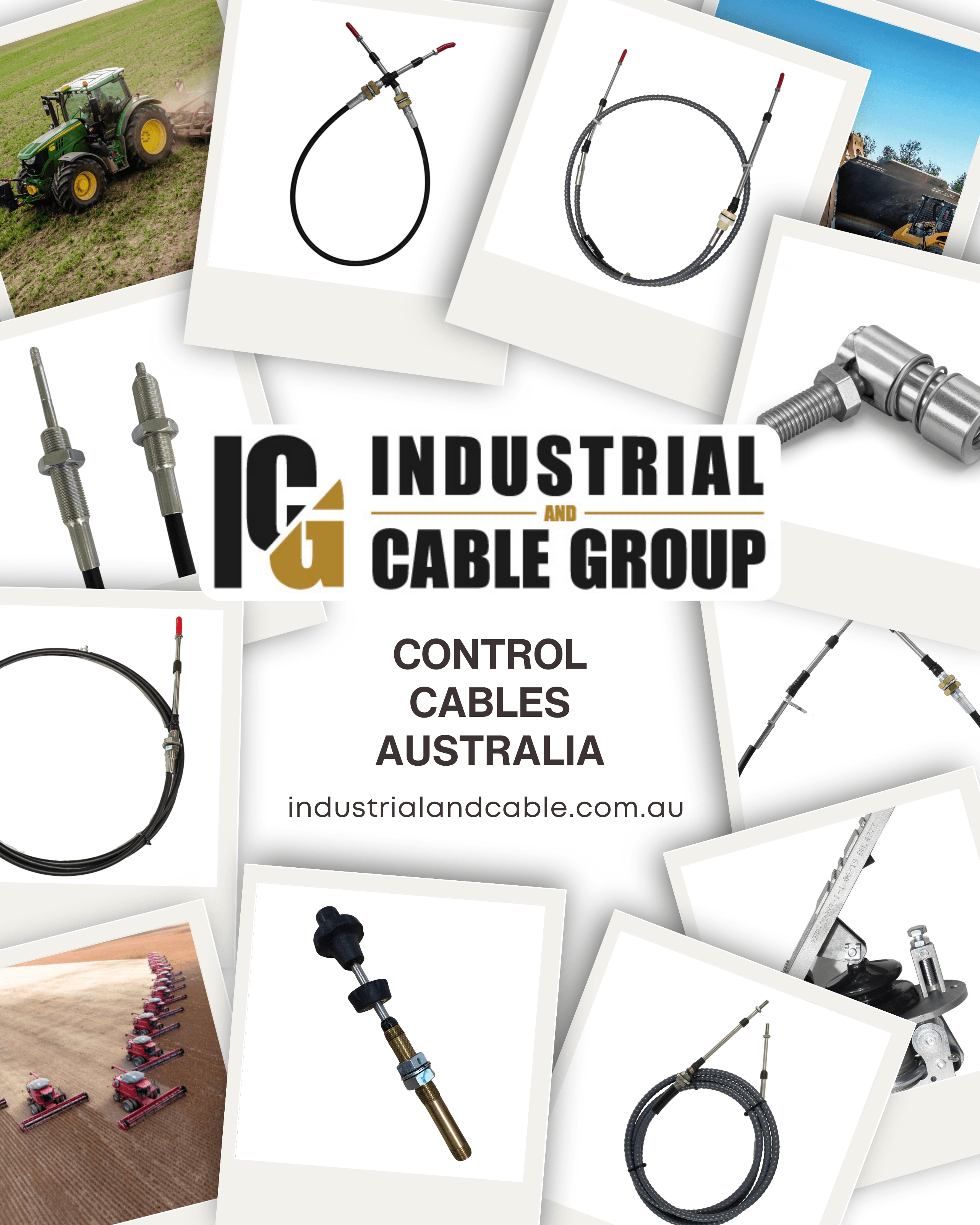 "Control Cables Australia: The Complete Guide to Mechanical Control Cables")
Control Cables Australia: The Complete Guide to Mechanical Control Cables
Mechanical control cables are used across countless industries to transfer motion, regulate machinery and provide precise equipment control. From agricultural machinery and heavy equipment to trucks and marine systems, these cables play a critical role in keeping machines operating safely and efficiently.
This guide explains what control cables are, how they work, where they are used and how to choose the right cable for your application.
What Are Mechanical Control Cables?
A mechanical control cable is a flexible cable system designed to transmit motion from one location to another. The cable allows operators to control machinery remotely by pushing or pulling a cable connected to a lever, knob or handle.
Mechanical control cables are widely used because they provide reliable and precise control without relying on electrical systems.
These cables typically consist of two main components:
Inner cable (core wire)
The inner cable moves back and forth to transfer motion.
Outer conduit (casing)
The conduit protects the inner cable and guides its movement.
When a control is operated, the inner cable slides inside the conduit to activate the connected component.
Types of Control Cables
Different applications require different types of mechanical control cables. Some of the most common cable types include the following.
Push-Pull Control Cables
Push-pull cables are designed to transmit motion in both directions. The cable can push and pull, allowing precise control of equipment functions.
These cables are commonly used for:
Throttle controls
Hydraulic valve actuation
Engine controls
Equipment positioning
Push-pull cables are one of the most widely used cable systems in industrial machinery.
Pull-Only Cables
Pull-only cables operate in one direction. The cable pulls to activate the mechanism, and a spring or external force returns it to its original position.
Typical uses include:
Brake systems
Safety shut-offs
Release mechanisms
Pull-only cables are simpler but still provide reliable mechanical control.
Vernier Control Cables
Vernier control cables allow fine adjustments and precise control. They are often used where equipment requires incremental adjustment.
These cables are commonly found in:
Engine speed control
Industrial machinery
Generator equipment
Twist Lock Control Cables
Twist lock cables allow the operator to lock the control in position. Once set, the control remains fixed until manually adjusted.
These cables are often used in applications where a constant setting is required.
 "Industrial and Cable Group") Author:Industrial and Cable Group
Author:Industrial and Cable Group