&geometry(285x80) "Industrial and Cable Group")
Ball Joint Selection Guide: Compare Sizes, Threads & Types
 "Ball Joint Selection Guide: Compare Sizes, Threads & Types")
Finding the Right Ball Joint for Your Control Cable
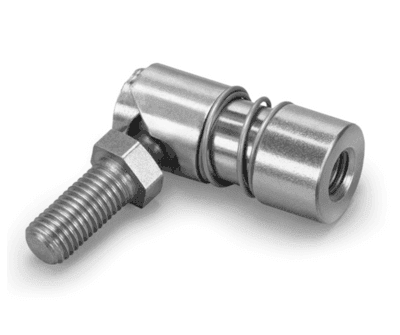
A ball joint is a small but important component in a mechanical control cable system. It provides the connection between the cable and the lever, actuator or mechanism being operated, allowing the cable to transfer movement while accommodating changes in alignment.
However, not all ball joints are interchangeable.
The correct ball joint depends on several factors, including thread size, stud size, ball joint type, material and the requirements of the application. Industrial & Cable Group supplies a range of ball joints for push-pull control cables, shifter cables, throttle cables and other mechanical linkage systems.
Our range includes metric fixed ball joints, UNF quick disconnect ball joints, plated steel ball joints and 300 Series stainless steel ball joints, along with specialised options such as the K9 ball joint for selected Universal Cable applications.
Use the comparison tables below to identify the ball joint that best matches your existing cable and linkage.
Metric Fixed Ball Joints
| SKU | Thread | Stud | Material | Finish |
|---|---|---|---|---|
| 21304 | M6 x 1.00 | M6 x 1.00 | Plated steel | Zinc clear |
| 21306 | M8 x 1.25 | M8 x 1.25 | Plated steel | Zinc clear |
| 21308 | M10 x 1.50 | M10 x 1.50 | Plated steel | Zinc clear |
UNF Quick Disconnect Ball Joints
| SKU | Housing Thread | Stud Thread | Material | Finish |
|---|---|---|---|---|
| 21200 | 3/16" / 10-32 UNF | 3/16" / 10-32 UNF | Plated steel | Zinc plated |
| 21202 | 3/16" / 10-32 UNF | 1/4-28 UNF | Plated steel | Zinc plated |
| 21205 | 1/4-28 UNF | 1/4-28 UNF | Plated steel | Zinc plated |
| 21207 | 1/4-28 UNF | 5/16-24 UNF | Plated steel | Zinc plated |
| 21208 | 5/16" UNF | 5/16" UNF | Plated steel | Zinc plated |
| 21212 | 3/8-24 UNF | 3/8-24 UNF | Plated steel | Zinc plated |
Stainless Steel Quick Disconnect Ball Joints
| SKU | Housing Thread | Stud | Material | Finish |
|---|---|---|---|---|
| 21203 | 3/16" / 10-32 UNF | 3/16" / 10-32 UNF | 300 Series Stainless Steel | Polished |
| 21206 | 1/4-28 UNF | 1/4-28 UNF | 300 Series Stainless Steel | Polished |
| 21209 | 5/16-24 UNF | 5/16-24 UNF | 300 Series Stainless Steel | Polished |
| 21214 | 3/8-24 UNF | 3/8-24 UNF | 300 Series Stainless Steel | Polished |
| K9 | 3/16" / 10-32 UNF female | 6 mm | 300 Series Stainless Steel | Polished |
Frequently Asked Questions About Cable Ball Joints
What is a cable ball joint?
A cable ball joint is a mechanical linkage component used to connect a control cable to a lever, actuator or other operating mechanism. The ball-and-socket design allows the connection to accommodate angular movement while transferring the movement of the cable to the mechanism.
What are control cable ball joints used for?
Control cable ball joints are commonly used with mechanical control cables, including push-pull cables, shifter cables, throttle cables and other cable-operated mechanisms. They can be found in industrial machinery, agricultural equipment, transport equipment, marine applications and other mechanical control systems.
How do I choose the correct ball joint for my control cable?
Start by identifying the required thread size and stud size. You should then determine whether you require a fixed or quick disconnect ball joint and whether plated steel or stainless steel construction is appropriate for the application.
It is important to compare the ball joint with the existing cable and the mechanism it connects to rather than selecting a ball joint based on appearance alone.
What is the difference between a fixed ball joint and a quick disconnect ball joint?
A fixed ball joint provides a permanent-style connection between the cable and linkage. A quick disconnect ball joint incorporates a spring-loaded mechanism that allows the stud to be released from the housing, making it easier to disconnect the cable or linkage for servicing, adjustment or maintenance.
What is a quick release ball joint?
A quick release ball joint is a ball joint designed to allow the connected cable or linkage to be released quickly. In the Industrial & Cable Group range, quick release ball joints use a spring-loaded mechanism that allows the housing to be moved to release the stud.
What does 10-32 UNF mean?
10-32 UNF identifies a Unified National Fine thread with a nominal size of approximately 3/16 inch and 32 threads per inch. It is commonly encountered in smaller mechanical control and linkage components.
What does 1/4-28 UNF mean?
1/4-28 UNF identifies a 1/4 inch Unified National Fine thread with 28 threads per inch.
What does 5/16-24 UNF mean?
5/16-24 UNF identifies a 5/16 inch Unified National Fine thread with 24 threads per inch.
What does 3/8-24 UNF mean?
3/8-24 UNF identifies a 3/8 inch Unified National Fine thread with 24 threads per inch.
What metric ball joint sizes are available?
The Industrial & Cable Group plated steel range includes M6 x 1.00, M8 x 1.25 and M10 x 1.50 fixed ball joints.
What UNF ball joint sizes are available?
The range includes several UNF configurations, including 3/16" x 3/16", 3/16" x 1/4", 1/4" x 1/4", 1/4" x 5/16", 5/16" x 5/16" and 3/8" x 3/8".
What is the difference between the housing thread and the stud thread?
The housing thread refers to the thread used to attach the ball joint housing to the control cable or another component. The stud thread is the threaded connection on the ball that attaches to the operating mechanism.
Some ball joints have the same thread size on both components, while others have different housing and stud thread sizes.
Why do some ball joints have different thread sizes?
A ball joint may have different housing and stud thread sizes when the cable and the mechanism it connects to require different thread dimensions. For example, a ball joint can provide a smaller cable connection while connecting to a larger threaded component on the operating mechanism.
What material are the ball joints made from?
Industrial & Cable Group supplies ball joints manufactured from plated steel and 300 Series Stainless Steel.
The plated steel range has zinc-clear or zinc-plated finishes, while the stainless steel range has a polished finish.
What is the difference between plated steel and stainless steel ball joints?
Plated steel ball joints provide a practical solution for many general mechanical control cable applications. Stainless steel ball joints provide stainless steel construction and a polished finish and may be preferred where stainless steel is required by the application or installation environment.
The correct material depends on the operating environment, exposure conditions and requirements of the application.
Can ball joints be used with push-pull control cables?
Yes. Ball joints are commonly used with push-pull control cables to connect the cable to the mechanism being operated.
Can ball joints be used with throttle cables?
Yes. Cable ball joints can be used with mechanical throttle cable systems where the thread, stud and ball joint configuration match the application.
Can ball joints be used with shifter cables?
Yes. Ball joints are commonly used with mechanical shifter and shift-control cable systems where the correct connection configuration is required.
What should I check before ordering a replacement ball joint?
Before ordering, check:
- The thread size
- The thread standard – metric or UNF
- The stud size
- The housing dimensions
- Whether the ball joint is fixed or quick disconnect
- The material and finish
- The available space around the connection
- The type of control cable being used
- The load and movement requirements of the application
Comparing the existing ball joint with the product specifications is the best way to confirm compatibility.
Where can I buy replacement control cable ball joints in Australia?
Industrial & Cable Group supplies a range of replacement and accessory ball joints for mechanical control cable applications in Australia, including metric, UNF, plated steel and stainless steel options.
Need Help Choosing the Right Ball Joint?
With different thread sizes, stud configurations, materials and connection types available, choosing the correct ball joint can be difficult if you don't have the original specifications.
Use the comparison tables in this guide to narrow down your options, then check the individual product page for detailed dimensions and specifications.
If you are still unsure which ball joint is suitable for your control cable, contact the Industrial & Cable Group team for assistance with identifying the correct component.
 "Industrial and Cable Group") Author:Industrial and Cable Group
Author:Industrial and Cable Group